
Ranking the biggest stadiums in Europe: Camp Nou reigns supreme, Old Trafford makes the list
Every elite football club in the world harbors a deep-seated desire to possess a home that matches its stature and rich traditions. This ambition extends far beyond the practical need to accommodate more spectators or to boost seasonal match-day revenue. Owning a venue with a massive seating capacity is the most profound testament to a club's value, power, and honor.
Furthermore, in the broader geopolitical context of sports, a grand stadium allows a club to exert "soft power" within its nation and across the continent. These "cathedrals" of sport attract prestigious non-football events, ranging from sold-out concerts to international summits, which not only fills the club’s coffers but also acts as a massive catalyst for national tourism.
Consequently, many clubs remain determined to renovate or build new homes even during financial hardships, often with government backing, as these structures are viewed as vital national assets. Europe, as the epicenter of global football excellence, naturally hosts the most prestigious sanctuaries in history. Flashscoremobi understands the significance of these sporting monuments, and below is the definitive list of the biggest stadiums in Europe today.
The 10 biggest stadiums in Europe
10. Allianz Arena (75,024)
Located in the heart of Bavaria, the Allianz Arena officially opened on May 30, 2005, costing approximately €340 million. It serves as the fortress for Bayern Munich. This architectural marvel, designed by Herzog & de Meuron, is globally unique for its outer shell made of 2,874 air-filled ETFE plastic cushions that can change color entirely, earning it the nickname "The Inflatable."
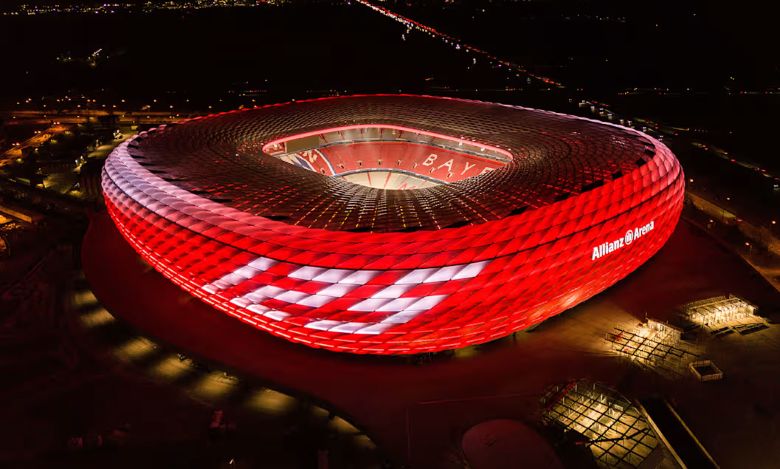
While it is the second-largest stadium in Germany for international matches, its modern amenities are praised by experts as the gold standard for fan comfort. It famously hosted the 2006 World Cup opening match and the 2012, 2025 Champions League finals.
9. Old Trafford (74,310)
Known as the "Theatre of Dreams," Old Trafford has been the home of Manchester United since 1910. As the largest club stadium in the UK, its history is unparalleled, having survived bombings in WWII followed by major renovations in the 1990s and 2000s. However, the venue is currently showing its age, with reports of leaking roofs and infestations.
Sir Jim Ratcliffe’s INEOS has recently proposed a £2 billion "New Trafford" project to create a 100,000-seater stadium. Despite its current physical decline, the atmosphere remains legendary, having hosted the 2003 Champions League final and countless historic Premier League title deciders under Sir Alex Ferguson.
8. Atatürk Olympic Stadium (76,092)
Built for Turkey’s 2008 Olympic bid and opened in 2002 at a cost of $140 million, this is Turkey's largest venue. It is best known for the "Miracle of Istanbul" in 2005, where Liverpool overturned a 3-0 deficit against AC Milan to win the Champions League. More recently, it hosted Manchester City’s first-ever Champions League triumph in 2023. Though it lacks a permanent club tenant, its vast, wind-swept bowl design provides a dramatic backdrop for the most high-stakes matches in European football.
7. San Siro (80,018)
Shared by rivals AC Milan and Inter Milan since 1926, San Siro is a brutalist masterpiece characterized by its 11 cylindrical towers. It is the largest stadium in Italy and has hosted the World Cup in 1934 and 1990. Despite its iconic status, the stadium faces a dark future with plans for demolition or major refurbishment, leading UEFA to withdraw its 2027 Champions League final hosting rights due to uncertainty.
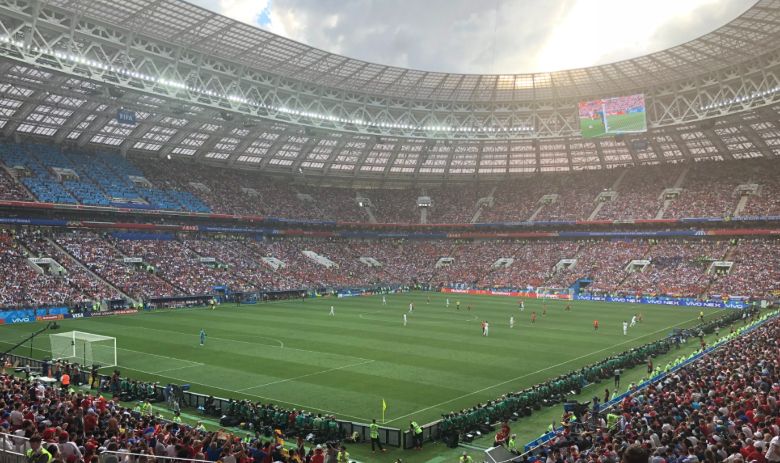
6. Luzhniki Stadium (81,006)
Originally opened in 1956 as the Central Lenin Stadium, it underwent a €350 million reconstruction for the 2018 World Cup, which removed the athletics track to bring fans closer to the action. It is the largest stadium in Russia and famously hosted the all-English 2008 Champions League fnal where Man United defeated Chelsea. A tragic stampede in 1982 that claimed 66 lives remains a somber part of its history, but today it stands as a high-tech hybrid-grass marvel.
5. Stade de France (81,338)
Constructed for the 1998 World Cup, this venue serves the French national football and rugby teams. It is a rare venue to have hosted both Football and Rugby World Cup finals. While praised for its design, it was the site of controversy during the 2022 Champions League final due to organizational failures. Nevertheless, it remains the crown jewel of French infrastructure, recently playing a central role in the 2024 Paris Olympics.
4. Estadio Santiago Bernabéu (81,044)
The home of Real Madrid since 1947, the Bernabéu recently completed a massive €1 billion renovation. The "New Bernabéu" features a retractable roof and a sophisticated underground system to store the pitch, allowing the venue to host NFL games and concerts year-round. While its capacity was once over 120,000 in the 1950s, the modern, all-seater version focuses on luxury and technology, solidifying its status as the most modern stadium in the world.
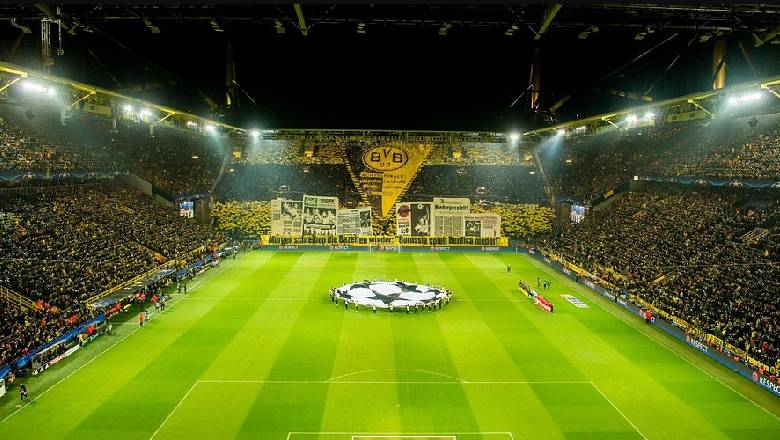
3. Signal Iduna Park (81,365)
Opened in 1974 and home to Borussia Dortmund, this stadium houses the "Yellow Wall", the largest standing terrace in Europe with 24,454 passionate fans. Experts consistently rate it as having the best atmosphere in Europe. Its unique rectangular design and yellow steel pylons make it an unmistakable silhouette in the footballing world.
2. Wembley Stadium (90,000)
The new Wembley, opened in 2007 for £789 million, is famous for its 133-meter-tall arch. It is the home of English football and the venue for every FA Cup final. It has hosted more modern Champions League finals (2011, 2013, 2024) than any other venue. With 2,618 toilets, it holds a quirky world record, but its true value lies in its prestige as the "home of football," where legends are made under the London lights.
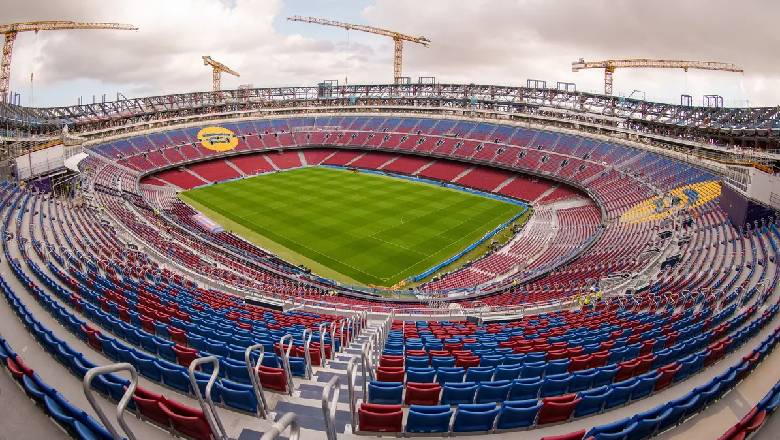
1. Spotify Camp Nou (99,354)
Camp Nou has been Barcelona’s home since 1957. It is currently undergoing a £1.25 billion renovation to increase capacity to 105,000. As of March 2026, the club has begun a phased return to the venue. The stadium has hosted 2 Champions League finals and the 1982 World Cup. Once fully completed in June 2026, it will be the only stadium in Europe to exceed 100,000 seats, featuring a 360-degree screen and solar panels.
Summary list of the 10 largest stadiums in Europe:
Spotify Camp Nou (Barcelona, Spain) - 99,354
Wembley Stadium (London, England) - 90,000
Signal Iduna Park (Dortmund, Germany) - 81,365
Santiago Bernabéu (Madrid, Spain) - 81,044
Stade de France (Saint-Denis, France) - 81,338
Luzhniki Stadium (Moscow, Russia) - 81,006
San Siro (Milan, Italy) - 80,018
Atatürk Olympic Stadium (Istanbul, Turkey) - 76,092
Old Trafford (Manchester, England) - 74,310
Allianz Arena (Munich, Germany) - 75,000
As football becomes increasingly commercialized, clubs are finding new ways to improve annual revenue, and world-class stadiums are being born as a result. Following the footsteps of Real Madrid and Barcelona, other giants such as Man United, Arsenal, Chelsea, Newcastle United, and Valencia are all harboring ambitions to upgrade or build new, more modern homes. These projects promise to shake up the rankings of the biggest stadiums in Europe on Flashscoremobi.com in the near future.
Make sure to stay with us for a moment longer. For those seeking a premier digital hub that delivers up-to-the-second football news alongside deep tactical insights and essential pre-game statistics, our platform is designed to exceed your expectations. Experience the difference by exploring our full suite of features today.
The Most Popular
-
 How many games are there in a Bundesliga season per team?
 -
 Why is football so popular in Spain?
 -
 6 Brazil's biggest wins in football history: The shocking 9-goal thrashing of Argentina
 -
 Ranking the 5 dark horses for the 2026 World Cup: Waiting for Haaland’s debut, 2 Asian teams to watch
 -
 10 football players who played for Real Madrid and Barcelona: Figo the “traitor”, Eto'o’s costly mistake
 -
 What position does Erling Haaland play?
 -
 Brazil national football team squad for the 2026 World Cup predicted: Casemiro’s last shot, Neymar in the spotlight
 -
 Why did De Bruyne leave Man City?
 -
 How much did Real Madrid pay for Camavinga?
 -
 How much did Real Madrid pay for Eden Hazard?